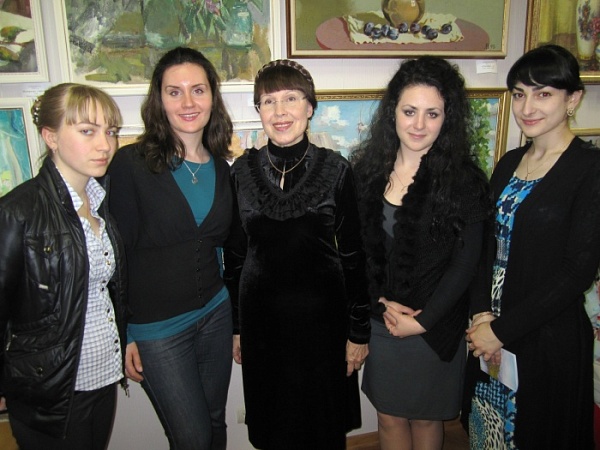
Krasnodar, 8 July. Our today’s interviewee, the poetess Nelli Vasilinina, turned 80 on June 25.
Q.: With what feeling did you meet your jubilee?
A.: I had a feeling that time is material and palpable, and I even was able to visualize the known expression ‘through the thickness of years’. If I turn back through all years of my life, I can see myself a threeor four-year girl in my first reminiscences which look much like splashes of light. We lived in Tobolsk. It was 1944. Dad was at the front, and Mum was working from morning till night. When the Great Patriotic War ended, Dad summoned our big family to Krasnodar where he was completing his cure after a severe wound. My tenacious memory of a child keeps the minutest details of our life: the oven stoked with firewood; baked onions would substitute the mysterious marmalade; a hair’s tail – Dad’s hunting trophy – that was my toy. Our most frequent meal was maize porridge. Granddad husked the kernels off the ear, ground them in a manual grinder – I think, we called it ‘hulling mill’.
Q.: Who was the first to listen to your poems?
A.: I knew that we had amateur poets at our factory. I approached one of them with a thin pile of sheets of paper full of ‘words written in columnar form: I had written several poems at once, as if they had shot ahead to paper. When I got my first lesson in poetry and advice to go to the literary club at the Community Centre of the Measuring Equipment Factory, I began to attend their classes and I was so thirsty of knowledge that I went to all clubs which existed in the city. They were run by well-known writers and poets – Yuri Abdashev, Vasili Popov, Vitali Bakaldin, Vadim Neppodoba, Igor Kravchenko, and Kronid Oboishchikov with Valeri Gorsky. They were my first tutors, but my main teachers were the authors of numerous literary studies, because I had understood by then that ‘any genuine education can be achieved only through self-education.’
Q.: What does the poet’s responsibility mean, or how does it show itself?
A.: A poet should be not only responsible but also brave to be able to expose his heart before other people, as if at confession. Then the people would be able to see themselves in yourself, acknowledge your feelings, and, maybe, even see the long-awaited light at the end of the tunnel. You can’t write poems – they just happen, when your soul gets uneasy about your or somebody else’s pain. Then the words would come by themselves. Or they would not. Then you would be looking for the badly needed word somewhere in your underself until you finally find it. The more you put in your words, the more you took out of your heart.
Q.: They say that a poet is lonesome. Is it true?
A.: A poet is not always and not necessarily lonesome, but what he or she really needs for creation and self-development is solitude.
Follow our news on Facebook
За всеми важными новостями следите в MAX, Telegram, во «ВКонтакте», «Одноклассниках», YouTube и на Rutube