Krasnodar, 6 August. The regional coronavirus monitoring centre has announced that the sickness rate is growing. This is why the regional authority has decided to prolong the high alert regime until 21 August.
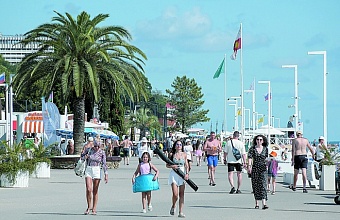
Last week, Sochi, which is overwhelmed with holidaymakers, was holding a meeting at which the governing companies were advised to reinforce disinfection of residential blocks.
Some our interviewees working at the seaside confessed that they fear that quarantine may again be introduced in the region in mid-September.
“The authorities may make loud announcement that the regime will be toughened in autumn, but most probably this is how they want to call people to observe the face mask requirement,” Valeri Yemelianov, Freedom Finance analyst, says. “The fact is that the prevailing majority of the population do not observe this requirement, and the officials see it as the reason for the growing sickness rate.” Aleksei Korenev, FINAM analyst, asserts that now it is impossible to forecast whether new constraints will be imposed, and if yes then for how long and to what extent. He says, that coronavirus continues to behave absolutely unpredictably. In certain countries the pandemic has almost been beaten (China and several Asian-Pacific countries); others are undergoing the stabilisation process (Europe); in some countries the illness is in full swing (Brazil), or all main problems would only come (India); while a completely new virus, a COVID-19 mutant much more contagious than its parent, was revealed in Vietnam.
“Nonetheless, it would be wrong not to reckon for possible introduction of the new quarantine,” he says. “It means that the business circles must be thinking of this variant too and plan their expenditures and make activity plans accordingly.”
Valeri Yemelianov admits that the regional authorities may reinforce patrolling of public places and increase the frequency of collection of penalties. But it is out of the question that the hotels and restaurants would have to close again.
“There may be certain episodes and directions,” he summed up.
Aleksei Korenev is confident that for small and midsize businesses it would be extremely difficult to overcome the second wave of the coronavirus, because its first wave already hit them more than others. Those who survived did it by using all their resources. So, even if the second wave would not be as grave as the first one, small companies would be having a rough time.
“In this respect, governmental assistance would be extremely important. Luckily, lots of mistakes have enabled them to accumulate certain experience not to shoot themselves in the foot twice and to act more efficiently,” the analyst says. “On the other hand, if quarantine restrictions would be introduced at least in October and not in mid-September (in the height of the season), it would enable small and medium businesses accumulate at least some resources for further surviving.”
Follow our news on Facebook
За всеми важными новостями следите в MAX, Telegram, во «ВКонтакте», «Одноклассниках», YouTube и на Rutube